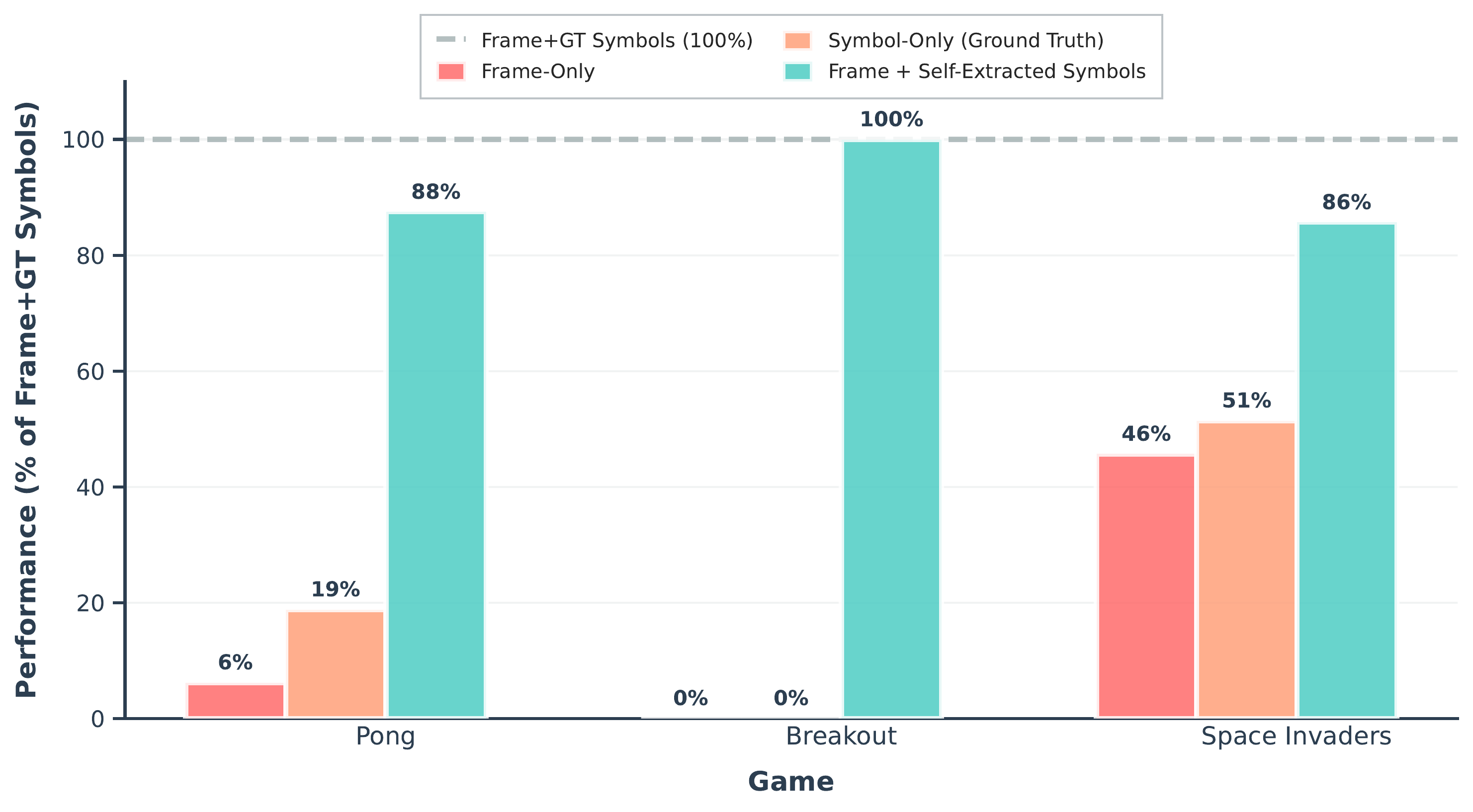
Vision-Language Models (VLMs) excel at describing visual scenes, yet struggle to translate perception into precise, grounded actions. We investigate whether providing VLMs with both the visual frame and the symbolic representation of the scene can improve their performance in interactive environments. We evaluate three state-of-the-art VLMs across Atari games, VizDoom, and AI2-THOR, comparing frame-only, frame with self-extracted symbols, frame with ground-truth symbols, and symbol-only pipelines. Our results indicate that all models benefit when the symbolic information is accurate. However, when VLMs extract symbols themselves, performance becomes dependent on model capability and scene complexity. Our findings reveal that symbolic grounding is beneficial in VLMs only when symbol extraction is reliable, and highlight perception quality as a central bottleneck for future VLM-based agents.